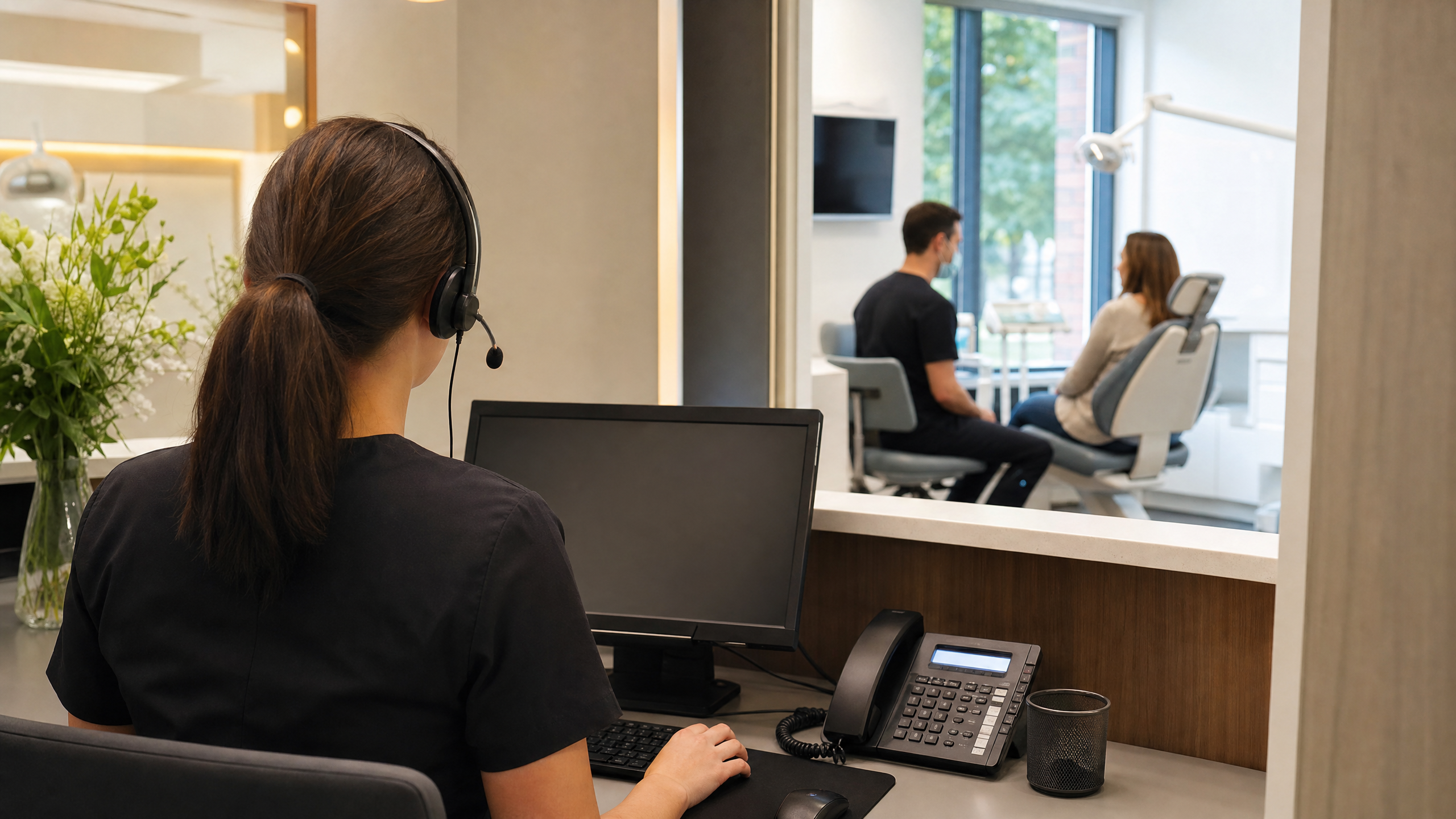
A patient walks out of the operatory nodding politely. They have just heard the words “deep cleaning,” “periodontal maintenance,” and “we’ll monitor that crown margin,” but what they remember in the car park is simpler: Am I in trouble? How much is this going to cost? Do I really need to come back so soon?
That gap between what the dental team explained and what the patient understood is where many clinic problems begin. It can show up as a missed follow-up appointment, a nervous phone call three days later, a delayed treatment decision, or a one-star review that says, “Nobody explained what was happening.”
Dental communication is difficult because the work is clinical, personal, visual, time-sensitive, and often expensive. It also happens across multiple channels: front-desk calls, chairside explanations, treatment plans, reminders, financing conversations, post-treatment instructions, and recall messages. No single AI tool fixes all of that. But the right mix of tools can make communication clearer, more consistent, and less dependent on one overloaded receptionist or hygienist remembering every detail.
This guide breaks down the practical AI tool categories dental clinics should evaluate, where each one fits, and how to calculate whether the investment is worth it.
Why dental communication breaks down so easily
Dental teams often assume communication problems happen because patients “do not listen.” In reality, the system is usually too fragmented. One person explains treatment chairside, another handles insurance questions, and a third confirms the appointment by phone. If the patient receives slightly different wording from each person, confusion is predictable.
The cost of that confusion is not just emotional. Dental appointments tend to be longer than standard primary care visits. One study on dental appointment no-shows noted that average dental appointments were reported at 48.7 minutes, compared with 17.4 minutes for primary care appointments, making an empty dental chair particularly expensive.[^1] The same paper described patient no-shows as a major healthcare problem and found that prior no-show history is one of the strongest indicators of future attendance risk.[^1]
A clinic does not need to solve every communication problem at once. It needs to identify where misunderstanding most often turns into operational waste.
| Communication moment | Common failure | Operational result | Useful AI support |
|---|---|---|---|
| First phone call | Patient asks a vague question and receives a rushed answer | Lost booking or wrong appointment type | AI call handling and structured intake |
| Appointment reminder | Patient receives a generic reminder but still has concerns | Cancellation or no-show | Smart reminders with two-way responses |
| Treatment presentation | Patient hears technical language without a plain-English summary | Delayed acceptance | AI-assisted treatment summaries |
| Post-op care | Patient forgets instructions after leaving | Avoidable callbacks | Automated follow-up messages |
| Recall | Patient does not understand why six-month visits matter | Lower retention | Personalized recall sequences |
This is similar to the problem many service businesses face when calls and explanations pile up during peak hours. We have covered that pattern in restaurant environments in our analysis of front-of-house AI training, and the underlying lesson applies to healthcare too: clarity usually improves when the process is repeatable.
Tool category 1: AI phone agents for first-contact clarity
The first phone call is often where patients form their first impression of the clinic. They may ask whether the clinic takes their insurance, whether a toothache counts as an emergency, how soon they can be seen, or how much an exam costs. A busy receptionist may know the answers, but they may not have time to collect the full context.
AI phone agents can help by answering common questions, capturing structured information, and routing urgent cases correctly. For dental clinics, the most useful configuration is not a “robot receptionist” that pretends to be clinical staff. It is a narrow intake assistant that can gather details and escalate appropriately.
A practical intake flow might capture:
- whether the caller is a new or existing patient;
- the main reason for the call;
- pain level from 1 to 10;
- whether swelling, trauma, or fever is present;
- preferred appointment windows;
- callback consent and contact details.
The key is to keep the AI inside safe operational boundaries. It should not diagnose. It should not promise coverage. It should not interpret radiographs. It should help the clinic avoid missing the call and make sure the human team receives a useful summary.
For clinics comparing communication tools across industries, the broader AI voice agent overview is a useful starting point because it explains where voice AI is strong and where human escalation remains important.
Tool category 2: Smart reminders that do more than say “see you tomorrow”
Basic appointment reminders are useful, but smart reminders are better because they reduce uncertainty. A patient who receives “Your appointment is tomorrow at 10:00” may still be wondering whether they can eat beforehand, how long the visit will take, or whether they need to bring insurance details.
Automated reminders have measurable value. A Dental Tribune report on a Sesame Communications study said the analysis covered 1,604,184 appointments across 64 dental practices and found that no-shows fell by 22.95% after automated appointment reminders were implemented.[^2] The same article reported that 79.5% of dental patients preferred SMS text and email reminders over phone calls from the practice.[^2]
For a clinic, that creates a straightforward business case. Suppose a practice books 900 appointments per month and has an 8% no-show rate. That means 72 empty appointments. If reminders reduce no-shows by 22.95%, the clinic prevents about 17 missed appointments per month.
| Monthly appointments | Current no-show rate | Missed visits | Reduction assumption | Visits recovered |
|---|---|---|---|---|
| 900 | 8% | 72 | 22.95% | 16.5 |
If the average recovered visit is worth $180 in production, the monthly value is roughly $2,970. If the average recovered visit is worth $300, the value is $4,950. That calculation is not perfect, but it gives the team a useful threshold: any reminder system costing less than the recovered production and administrative time saved deserves serious consideration.
The best reminder tools let patients reply. A simple “C” to confirm is helpful, but a better system can handle replies like “I need to reschedule,” “Do I need a driver?” or “How long is this appointment?” and then route the conversation to staff when needed.
Tool category 3: Plain-English treatment plan explainers
Dental terminology is precise for clinicians and confusing for patients. “Scaling and root planing” is routine language in a dental office; to a patient, it can sound alarming. AI writing assistants can help convert clinical notes into plain-English summaries, provided the output is reviewed by the dentist or treatment coordinator.
A good treatment summary should answer five patient questions:
- What did you find?
- Why does it matter?
- What are the options?
- What happens if I wait?
- What should I do next?
Here is the difference between a weak and strong explanation.
| Weak wording | Clearer wording |
|---|---|
| “You need SRP in two quadrants due to perio involvement.” | “We found signs of gum infection on the upper and lower left side. A deep cleaning in those areas helps remove bacteria below the gumline so the tissue can heal.” |
| “We are watching #19.” | “The lower left molar has an old filling with a small gap at the edge. It does not need treatment today, but we want to check it at your next visit.” |
| “Crown recommended.” | “The tooth has lost enough structure that a filling may not hold up well. A crown would cover and protect it so it is less likely to crack.” |
This kind of clarity is not just nicer writing. It reduces repeated phone calls, improves case acceptance conversations, and gives patients something they can reread after the appointment. For a broader look at why patients leave confused, see why dental patients leave without understanding their treatment plan.
Tool category 4: Translation and multilingual support
Many dental clinics serve patients who are comfortable speaking socially in English but less comfortable discussing pain, finances, medication, or consent. Multilingual communication tools can help, especially for appointment logistics, reminders, and post-care instructions.
The safest approach is to separate administrative translation from clinical interpretation. AI can be useful for reminders, directions, intake questions, and plain-language summaries. For clinical consent, diagnosis, or complex treatment decisions, clinics should follow local rules and use qualified human interpretation where required.
This is where process design matters. A clinic might use AI to send bilingual reminder messages and collect preferred language, then flag the chart so the team can prepare appropriate support before the patient arrives. That is very different from asking an unreviewed chatbot to explain surgical risks.
The same multilingual pressure appears in restaurants, salons, and other local businesses. If you want a cross-industry comparison, this restaurant-focused article on multilingual customer communication shows how language gaps affect bookings and customer confidence outside healthcare.
Tool category 5: Post-treatment follow-up and recall automation
Post-treatment communication is often where clinics can achieve quick wins. After an extraction, deep cleaning, filling, crown prep, or implant consultation, patients may leave with printed instructions but forget the details. AI-supported follow-up can send the right information at the right time.
A useful follow-up sequence might look like this:
| Timing | Message purpose | Example |
|---|---|---|
| 2 hours after visit | Reinforce immediate care | “Avoid chewing on the numb side until sensation returns.” |
| Next morning | Check symptoms | “Mild tenderness is common. Call us if swelling increases or pain is not controlled.” |
| 7 days later | Encourage next step | “Your gum tissue should be settling. Here is what to watch before your follow-up.” |
| 5 months later | Recall | “It is time to schedule your preventive visit before the calendar fills.” |
The tone matters. Patients should feel supported, not spammed. Every automated message should have a clear reason, a simple action, and an easy way to reach the clinic.
This is also where dental teams should be honest about their current bottleneck. If staff already struggle to answer calls, adding more follow-up messages without a response plan may create a new queue. If missed calls are part of the issue, it is worth reading how dentists can stop missing appointment calls before choosing another messaging tool.
How to choose the right AI communication stack
The best stack is not the one with the most features. It is the one that fits your clinic’s actual communication failure points. Start with a 30-day audit. Track missed calls, reschedule requests, no-shows, treatment-plan callbacks, untranslated conversations, and post-op questions. Then choose tools based on the largest preventable cost.
Here is a simple scoring model.
| Problem | Monthly volume | Estimated cost per event | Monthly exposure | AI tool priority |
|---|---|---|---|---|
| Missed new-patient calls | 25 | $250 | $6,250 | High |
| Hygiene no-shows | 18 | $160 | $2,880 | High |
| Repeated treatment questions | 40 | $12 staff time | $480 | Medium |
| Post-op callbacks | 30 | $10 staff time | $300 | Medium |
| Recall gaps | 80 inactive patients | Variable | Long-term | Medium |
Once you know the exposure, evaluate each tool against four questions. Does it integrate with your scheduling and patient communication workflow? Does it create a reviewable record? Does it escalate sensitive cases to humans? Does it make the patient experience clearer rather than merely cheaper?
Price should come after those questions. The cheapest tool that creates confusion is expensive. The best tool is the one that makes the next patient interaction easier for both sides.
For clinics looking beyond healthcare, the industries section provides a useful comparison of how different local businesses handle calls, reminders, and service conversations. The features overview is also helpful if you are mapping which capabilities matter most before comparing vendors.
The practical bottom line
Dental AI tools are most valuable when they reduce ambiguity. They should help patients understand what is happening, help staff capture the right information, and help the clinic protect the schedule from preventable gaps. Start with one high-cost communication point, measure the baseline, and improve it before adding another layer of automation.
Sources
[^1]: Yazeed Alabdulkarim et al., “Predicting no-shows for dental appointments,” PeerJ Computer Science, 2022. https://pmc.ncbi.nlm.nih.gov/articles/PMC9680883/ [^2]: Diana P. Friedman and Tim Williams, “Study reveals how automated patient appointment reminders affect dental practice no-show rates and production,” Dental Tribune, 2013. https://us.dental-tribune.com/news/study-reveals-how-automated-patient-appointment-reminders-affect-dental-practice-no-show-rates-and-production/
If your clinic wants to explore AI call handling and clearer patient communication without turning the experience into a hard sell, Speako’s main site explains the basics, and the pricing page can help you compare the cost against the recovered appointments and staff time in your own numbers.

Chief Product Specialist at Speako AI.