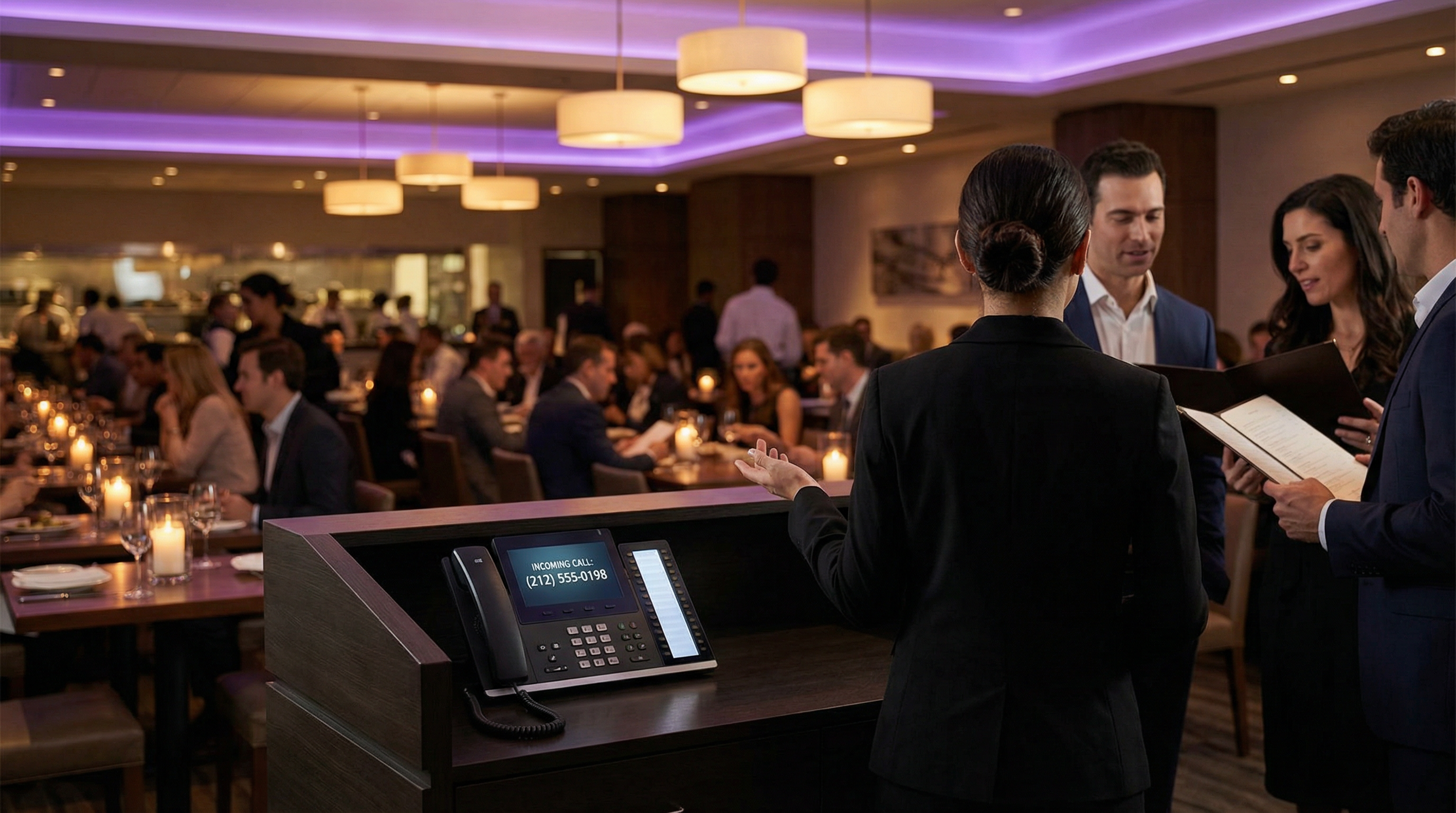
It is 7:15 PM on a Friday. The dining room is full, there is a queue at the door, and the kitchen is running at maximum capacity. Then, the phone starts ringing.
For front-of-house staff, this is the most stressful part of the shift. Do you ignore the guests standing right in front of you to answer the phone? Or do you let it ring out and hope they leave a voicemail or call back later? In most busy restaurants, the phone simply goes unanswered.
While every restaurant owner knows they miss calls during peak service, very few have actually quantified the problem. When you look at the real numbers, the cost of those unanswered calls is often much higher than anticipated.
The Real Data on Missed Restaurant Calls
Industry data paints a clear picture of what happens to restaurant phone lines during the lunch and dinner rush. Across the hospitality sector, restaurants miss an average of 20% to 30% of all inbound calls during their peak operating hours.
The distribution of these missed calls is not random. They heavily concentrate around two specific windows:
- The Pre-Service Rush (4:30 PM – 6:00 PM): Customers calling to make last-minute reservations, check wait times, or ask about parking.
- The Peak Service Window (7:00 PM – 8:30 PM): Diners calling to say they are running late, trying to modify their booking, or placing takeaway orders.
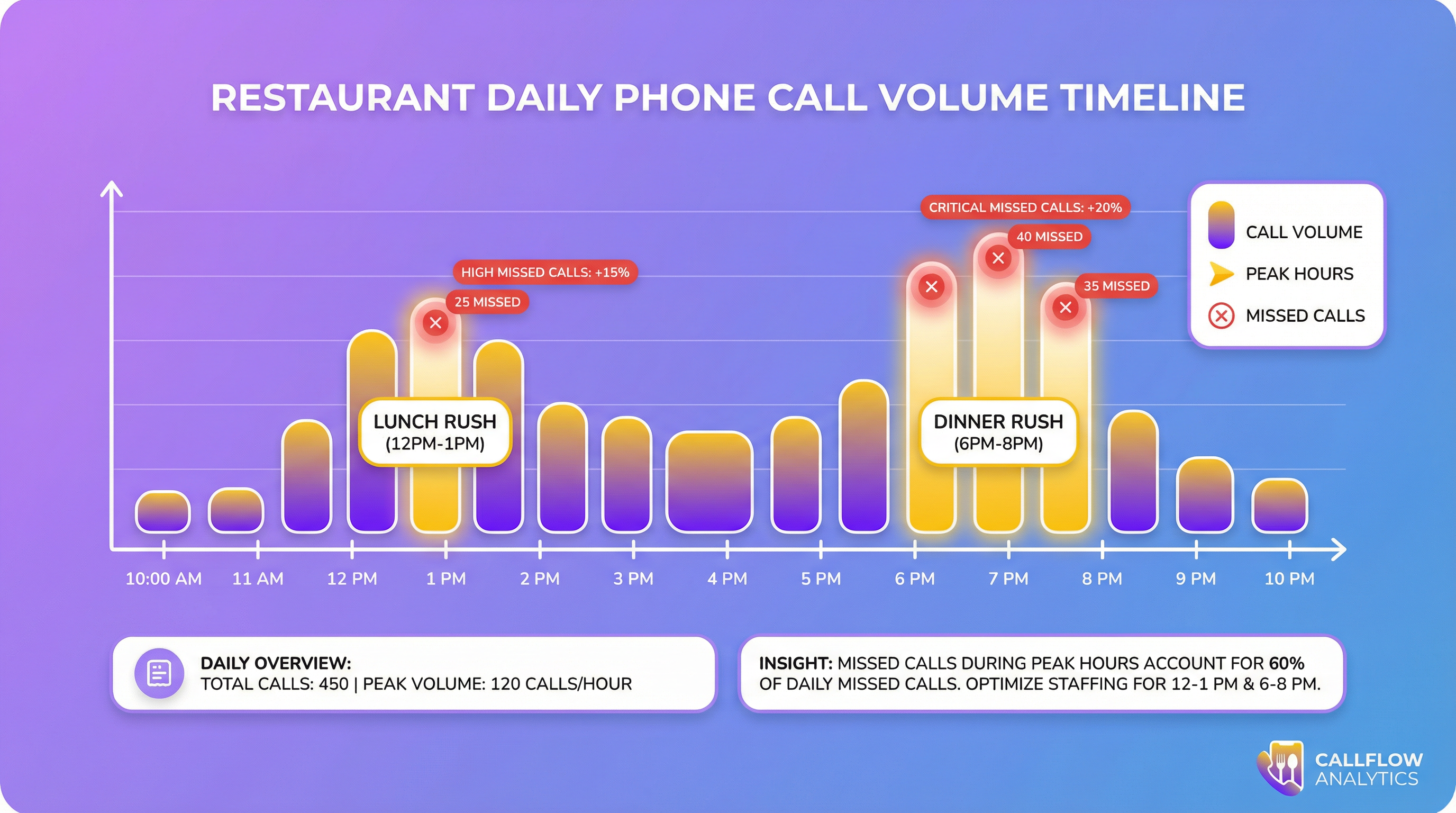
If your restaurant receives 50 calls during a busy Friday night service, missing 25% of them means 12 to 13 customers could not get through. Over a month, that number compounds into hundreds of missed interactions — each one a potential reservation that walked straight to a competitor.
Calculating the Financial Impact
Not every missed call is a lost booking. Some callers are simply asking for directions or confirming opening hours. However, a significant percentage of those callers are trying to spend money with your business.
To understand the true cost, consider a conservative scenario for a mid-tier restaurant:
| Metric | Value |
|---|---|
| Missed calls per week during peak hours | 40 |
| Percentage of calls with booking intent | 40% |
| Average party size | 2.5 people |
| Average spend per head | $60 |
If we calculate the lost revenue from those 16 missed booking opportunities (40 calls × 40% intent):
16 bookings × 2.5 people × $60 = $2,400 in lost revenue per week
That translates to over $120,000 in potential revenue left on the table annually, simply because the front-of-house team was too busy seating other guests to pick up the phone. For context, that figure often exceeds what restaurants spend on marketing and advertising in an entire year. You can read more about the broader financial impact of missed calls in our analysis of the hidden cost of missed calls for small businesses.
The Hidden Cost: Customer Experience and Retention
The financial calculation only tells half the story. The operational and reputational costs of missed calls can be just as damaging to a restaurant's long-term success.
The "No-Show" Domino Effect
When a customer is running 15 minutes late for their reservation, they will usually try to call the restaurant to let them know. If no one answers, they might assume their table will be given away and simply decide not to show up at all. What could have been a slightly delayed seating turns into an empty table and a complete loss of revenue for that slot.
This is a particularly painful scenario because the restaurant loses twice: the no-show table sits empty during peak service, and the guest who wanted to come leaves with a negative impression of the venue's communication.
The Competitor Pivot
Diners making last-minute plans are highly motivated but lack patience. If they call your restaurant to check for a table and the phone rings out, they rarely wait and call back. Instead, they move to the next option on their list. You have not just lost a booking — you have actively handed a customer to your local competitor.
Research in the hospitality sector suggests that over 60% of callers who cannot reach a restaurant on the first attempt will not try again. They simply book elsewhere. In competitive dining markets, that single unanswered call can mean the difference between a full house and an empty table.
Staff Stress and Burnout
The constant ringing of an unanswered phone adds a layer of ambient stress to an already high-pressure environment. Front-of-house staff feel torn between providing excellent service to the guests in the venue and managing the incoming communication. This friction contributes to staff burnout and turnover — two of the most expensive operational problems in the restaurant industry.
Why the Problem Is Getting Worse
Several trends are making the peak-hour phone problem more acute for restaurants:
Online discovery drives phone calls. When diners find your restaurant on Google, Instagram, or a review platform, many still prefer to call rather than book online — especially for larger parties, special occasions, or dietary enquiries. The rise of digital discovery has not reduced phone volume; in many cases, it has increased it.
Customer expectations have risen. Diners now expect instant responses. A phone that rings out or goes to voicemail feels like poor service before the meal has even started. In an era of same-day delivery and instant messaging, tolerance for unanswered calls is lower than ever.
Staffing remains tight. The hospitality industry continues to face staffing challenges globally. Many restaurants are operating with leaner front-of-house teams than they were five years ago, which means fewer people available to answer the phone during service.
How Restaurants Are Solving the Peak Hour Problem
Historically, restaurants had two flawed options for handling peak hour calls: hire a dedicated reservationist (which is expensive and inefficient during quiet periods), or let the calls go to voicemail (which frustrates customers and loses bookings).
Today, the landscape has changed. Modern restaurants are adopting smarter strategies to manage their communication flow without adding headcount.
1. Pushing Bookings Online
Many venues now use automated SMS replies for missed calls, instantly sending the caller a link to their online booking platform. While this captures some of the lost traffic, it does not help callers with specific questions — dietary requirements, parking availability, or whether the restaurant can accommodate a large group — and it excludes the significant portion of customers who simply prefer speaking to someone.
2. Off-Peak Call Routing
Some hospitality groups route their peak-hour calls to a centralised team or an off-site answering service. This ensures the phone is answered, but external operators often lack the specific venue knowledge required to provide a great guest experience. They cannot check real-time table availability, answer questions about today's specials, or handle requests with the same confidence as an in-house team member.
3. AI Voice Assistants for Restaurants
The most effective solution emerging in the industry is the use of AI voice agents specifically built for restaurants. These systems can answer multiple calls simultaneously, handle reservations in real time, answer common questions about dietary requirements or parking, and seamlessly integrate with existing booking platforms like OpenTable, SevenRooms, or Nowbookit.
Unlike a voicemail or a generic answering service, a well-configured AI voice assistant can check live table availability, confirm bookings instantly via SMS, and handle calls in over 30 languages — all without pulling a single staff member away from the dining room floor. For a deeper look at how this technology performs in practice, see our honest evaluation of whether AI receptionists for restaurants actually work.
A Simple Framework to Measure Your Own Missed Call Cost
Before dismissing this as someone else's problem, it is worth running the numbers for your own venue. Here is a straightforward framework:
- Check your phone logs for the past month. Most modern phone systems or VoIP providers can show you total inbound calls and missed calls by time of day.
- Identify your peak windows. Look for the hours where missed call rates spike above 20%.
- Estimate booking intent. For most restaurants, 30–50% of inbound calls during peak hours have booking intent.
- Calculate the revenue gap. Multiply missed booking-intent calls by your average party size and average spend per head.
Even a conservative estimate usually produces a number that is uncomfortable to sit with — and motivating to act on.
The Bottom Line
Missed calls during peak hours are not just an unavoidable reality of the restaurant business. They are a measurable, quantifiable leak in your revenue stream that compounds week after week. The restaurants that take this problem seriously — and invest in solutions that keep their phones covered during the moments that matter most — consistently outperform those that treat it as background noise.
The good news is that this is now a solvable problem. Whether through better staffing, smarter routing, or AI-powered phone handling, there are practical options at every price point. The first step is simply measuring the gap.
If you are ready to stop losing reservations during your busiest services, explore how Speako handles restaurant phone calls — from peak-hour reservations to after-hours enquiries — so your team can focus on the guests already in the room.

Chief Product Specialist at Speako AI.