After-Hours Call Handling for Restaurants: What Are Your Options?
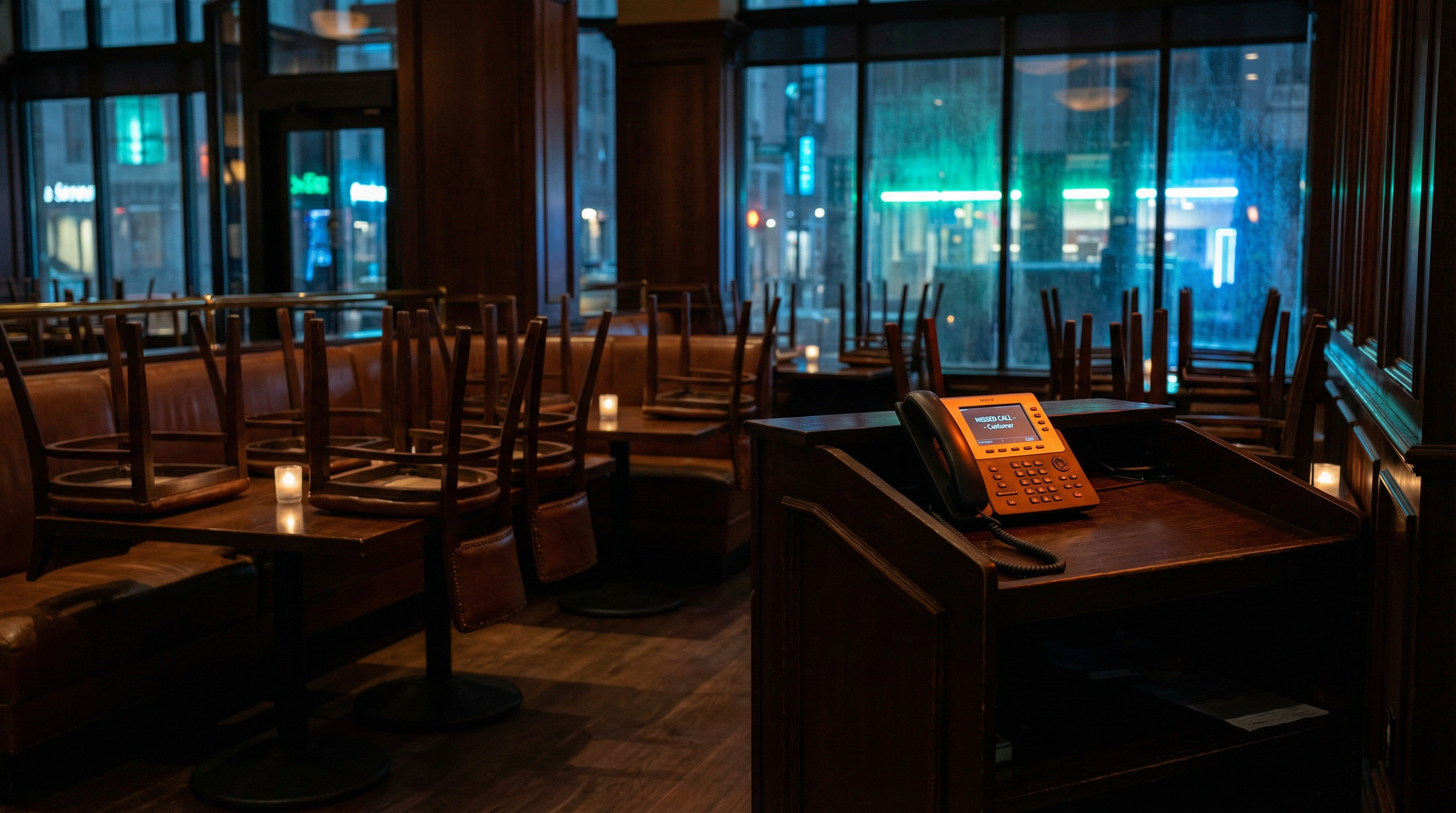
It is 10:47 PM on a Saturday night. Your restaurant closed thirty minutes ago, and the kitchen staff is halfway through clean-down. The phone rings. Then it rings again. And again. By the time you check the missed call log on Monday morning, there are nine calls from the weekend — three of which were from customers trying to book large party reservations for the following week. You will never know exactly how much revenue those calls represented, but the number is not small.
This is the after-hours problem that virtually every restaurant faces, and very few handle well. The hours between closing and opening are not dead time for customer demand. People plan meals, organise celebrations, and make dining decisions at all hours. If your restaurant is unreachable during these windows, you are handing business to competitors who have figured out how to stay accessible around the clock.
How Big Is the After-Hours Problem?
The scale of the issue is larger than most restaurant owners realise. Industry data suggests that restaurants receive between 15% and 25% of their total inbound calls outside of operating hours. For a busy restaurant fielding 40 to 60 calls per day, that translates to 6 to 15 calls per day that arrive when nobody is available to answer.
Not all of these calls are reservation requests, of course. Some are enquiries about the menu, questions about dietary accommodations, requests for directions, or calls about private event availability. But a significant portion — typically 40% to 60% of after-hours calls — involve a customer who is ready to commit to a booking or spend money.
| Call Type | % of After-Hours Calls | Revenue Impact |
|---|---|---|
| Reservation requests | 35-45% | Direct (lost covers) |
| Menu and dietary enquiries | 20-25% | Indirect (influences dining decision) |
| Private event and large party bookings | 10-15% | High (large ticket value) |
| General enquiries (hours, location, parking) | 15-20% | Low (but affects perception) |
| Existing reservation changes | 5-10% | Moderate (no-show risk if unresolved) |
As we explored in our analysis of how many calls restaurants miss during peak hours, the problem is not limited to after-hours. But the after-hours window is where the miss rate is effectively 100% for restaurants that have no coverage in place. Every single call goes unanswered.
Option 1: Standard Voicemail
The default approach for most restaurants is a recorded voicemail greeting. It is free, requires no setup beyond recording a message, and provides a basic level of acknowledgment. A typical greeting might say something like: "Thank you for calling. We are currently closed. Our hours are Tuesday to Sunday, 5 PM to 10 PM. Please leave a message and we will return your call."
The problem is that voicemail is a dead end for most callers. Studies consistently show that 75% to 85% of callers who reach a business voicemail do not leave a message. They hang up and either call a competitor or abandon the idea entirely. Among the small percentage who do leave a message, the restaurant then faces the challenge of returning those calls during the next business day — when staff are busy with prep, deliveries, and the lunch rush.
Voicemail also creates a poor first impression. For a new customer who has never visited your restaurant, reaching a voicemail can signal that the business is small, understaffed, or unresponsive. In a competitive dining market, first impressions matter enormously.
Best for: Restaurants with very low after-hours call volume (fewer than 3 calls per night) and no budget for alternatives.
Option 2: Third-Party Answering Services
A human answering service provides a live operator to handle calls on your behalf. The operator answers in your restaurant's name, takes messages, and may be able to process basic reservation requests depending on the service level. This approach ensures that every call is answered by a real person, which is a significant step up from voicemail.
However, answering services have notable limitations in the restaurant context. The operators typically handle calls for dozens of businesses across different industries, which means they lack the specific knowledge needed to represent your restaurant convincingly. When a caller asks about gluten-free options, the wine list, or whether the patio is available, a generic operator is unlikely to provide a satisfactory answer.
The cost structure is another consideration. Most answering services charge per call or per minute, with rates typically ranging from $0.75 to $1.50 per call. For a restaurant receiving 10 to 15 after-hours calls per night, this adds up to $225 to $675 per month — a meaningful expense for an independent restaurant operating on thin margins.
| Answering Service Tier | Typical Cost | What's Included | Limitations |
|---|---|---|---|
| Basic message-taking | $0.75-$1.00/call | Answer, take name and number | No booking capability |
| Mid-tier with scripts | $1.00-$1.25/call | Scripted responses, basic FAQs | Limited menu knowledge |
| Premium with booking | $1.25-$1.50/call | Can access booking system | Expensive at scale, still generic |
Best for: Restaurants that want human touch but have moderate call volumes and can tolerate some loss of brand authenticity.
Option 3: Redirecting to Online Booking
Many restaurants have adopted a hybrid approach: the voicemail greeting directs callers to the restaurant's website or online booking platform. The message might say: "To make a reservation, please visit our website at [restaurant name].com." This leverages existing technology to capture bookings without requiring any additional staffing or services.
This strategy works well for a specific segment of callers — those who are tech-savvy, have a straightforward booking request, and are willing to switch from a phone call to a digital platform mid-interaction. For these customers, the transition is seamless and even preferred.
But it fails for a significant portion of callers. Older customers, those with complex requests, and people who called specifically because they wanted a voice interaction are unlikely to follow through on the redirect. The conversion rate from "voicemail redirect" to "completed online booking" is typically below 20%, meaning 80% of those callers are lost.
There is also a fundamental mismatch in expectations. A customer who picks up the phone is signalling a preference for voice communication. Asking them to switch to a completely different channel introduces friction and can feel dismissive. It is the equivalent of walking into a shop and being told to order online instead.
Best for: Restaurants that already have a robust online booking system and primarily receive simple reservation requests after hours.
Option 4: Staff Mobile Forwarding
Some restaurant owners or managers forward the business line to their personal mobile phone after hours. This ensures that calls are answered by someone who genuinely knows the restaurant and can handle any enquiry with authority and authenticity.
The obvious downside is the impact on work-life balance. Restaurant owners already work gruelling hours, and adding after-hours phone duty creates a path to burnout. It is also unsustainable as a long-term solution — what happens during holidays, sick days, or when the owner simply needs a night off?
There are practical issues too. Calls forwarded to a mobile may not display the business name, making it difficult for the owner to distinguish between personal and business calls. Background noise from a home environment can undermine the professional impression. And if the owner is unavailable, the call simply goes to their personal voicemail, which is even worse than a business voicemail.
Best for: Very small, owner-operated restaurants as a short-term solution only.
Option 5: AI-Powered Voice Agents
The newest and most sophisticated option for after-hours call handling is AI-powered voice technology. These systems use natural language processing to conduct real conversations with callers, answering questions, providing information, and processing bookings — all without human intervention.
Unlike a basic voicemail or a generic answering service, a well-configured AI voice agent can be trained on your restaurant's specific details: the menu, dietary accommodations, operating hours, private dining options, parking information, and booking policies. When a customer calls at 11 PM asking whether you can accommodate a party of 12 with two vegetarians and a guest in a wheelchair, the AI can provide an informed, helpful response.
The technology has matured significantly in recent years. Modern AI voice agents sound natural, handle interruptions gracefully, and can manage multi-turn conversations that would have been impossible for automated systems just a few years ago. They operate 24/7 without fatigue, sick days, or salary costs, and they can handle multiple simultaneous calls — something no human receptionist can do.
The cost comparison is also favourable. While a human answering service might cost $400 to $600 per month for moderate call volumes, AI voice solutions typically operate at a fraction of that cost while delivering a more consistent and knowledgeable experience.
For a deeper look at how this technology performs in practice, our complete guide to AI receptionists for restaurants provides a thorough analysis of real-world implementations and results.
Best for: Restaurants of any size that want professional, knowledgeable, 24/7 call handling without the cost of additional staff.
Making the Right Choice for Your Restaurant
The right after-hours solution depends on your restaurant's specific circumstances: call volume, budget, the complexity of typical enquiries, and your growth ambitions. Here is a simplified decision framework:
If you receive fewer than 3 after-hours calls per night and they are mostly informational, a well-crafted voicemail with a redirect to online booking may suffice. If you receive 5 to 15 calls per night with a mix of reservations and enquiries, the economics start to favour an AI-powered solution over a human answering service. And if you are a high-volume restaurant receiving 15 or more after-hours calls nightly, the revenue at stake makes professional call handling not just advisable but essential.
Whatever you choose, the worst option is doing nothing. Every unanswered call is a missed opportunity, and in the restaurant industry — where margins are tight and competition is fierce — those missed opportunities add up fast.
If you are ready to explore how intelligent voice technology can transform your restaurant's after-hours operations, take a look at the advanced tools available through Speako for Restaurants. With solutions designed specifically for the hospitality industry, you can ensure that every caller receives a professional, knowledgeable response — whether they call at noon or midnight.

Content Lead at Speako AI. Covers the intersection of voice technology, customer experience, and service industry trends.