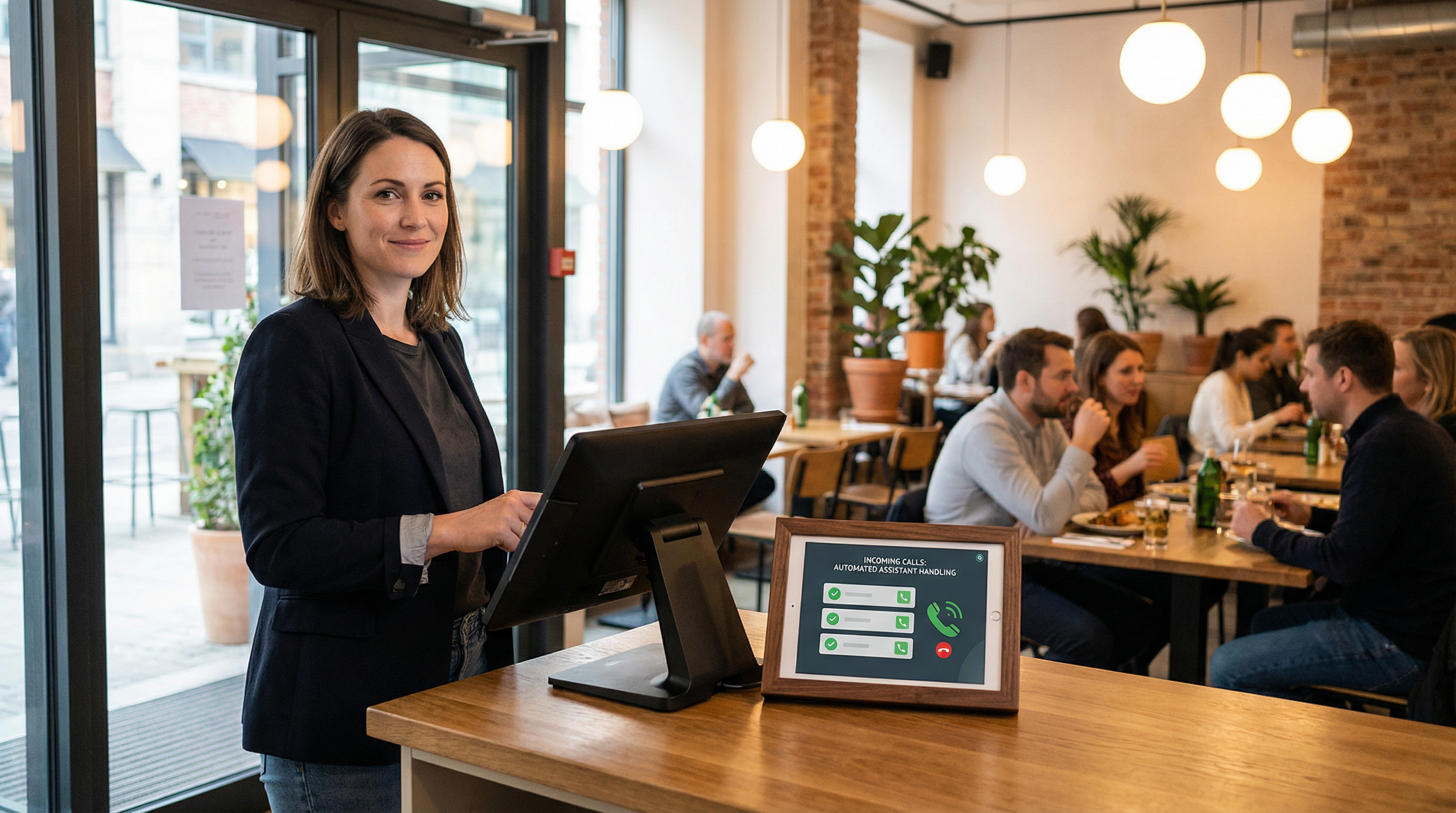
How to Reduce Missed Calls in Your Restaurant Without Hiring More Staff
The restaurant industry is facing a dual crisis: labor costs are at an all-time high, and customer expectations for immediate service have never been more demanding. When the phone rings during a Friday night dinner rush, operators are forced into an impossible choice: pull a staff member away from the floor to answer it, or let it ring out and potentially lose a booking.
For years, the conventional wisdom was simple: if you're missing calls, you need to hire a dedicated reservationist or add another host to the schedule. But in today's economic climate, adding headcount simply to manage phone lines is a luxury few independent restaurants can afford.
The good news is that you don't need to expand your payroll to solve your missed call problem. By implementing smarter operational strategies and leveraging modern technology, you can capture every booking while keeping your existing team focused on the guests in front of them.
The True Cost of the "Just Hire Someone" Approach
Before exploring solutions, it's important to understand why throwing more labor at the problem is often counterproductive.
Let's look at the math. A dedicated reservationist working just the peak hours (4 PM to 9 PM) five days a week at $18/hour costs approximately $23,400 annually, before factoring in payroll taxes, benefits, and training costs.
More importantly, call volume in restaurants is highly variable. As we discussed in our guide on why restaurants miss customer calls, calls tend to arrive in unpredictable spikes. A dedicated staff member might sit idle for 45 minutes, only to be overwhelmed by three simultaneous calls in the next five minutes. Human labor simply cannot scale up and down instantly to match this erratic demand.
| Solution | Upfront Cost | Ongoing Cost | Scalability |
|---|---|---|---|
| Dedicated Reservationist | High (Training) | ~$25k+ annually | Poor (Can only handle one call at a time) |
| Extra Host | Medium | ~$15k+ annually | Poor (Often pulled into floor duties) |
| Operational Optimization | Low | Minimal | Moderate |
| AI Voice Technology | Low | Subscription-based | Infinite |
Strategy 1: Optimize Your Online Presence
The most effective way to handle a phone call is to prevent it from needing to happen in the first place. A significant percentage of restaurant phone calls are "low-value" inquiries: customers asking for your hours, location, parking situation, or whether you have vegan options.
If your phone is ringing constantly with these questions, your digital presence is failing you.
Action Steps:
- Audit your Google Business Profile: Ensure your hours (including holiday variations), address, and menu link are accurate and prominently displayed.
- Make your website mobile-first: 80% of restaurant searches happen on mobile devices. If your menu is a difficult-to-read PDF, customers will give up and call you instead.
- Create an FAQ page: Address common questions about dress codes, corkage fees, and large party policies directly on your site.
Strategy 2: Implement Smart Call Routing
If you're still using a traditional analog phone line that rings at the host stand until someone picks it up, you're operating at a severe disadvantage. Modernizing your phone system doesn't require hiring staff, but it dramatically improves the efficiency of the staff you already have.
Action Steps:
- Set up an automated greeting (IVR): A simple menu ("Press 1 for hours and location, Press 2 for reservations, Press 3 to speak to a manager") can deflect up to 30% of routine calls automatically.
- Use time-based routing: During your busiest hours, route calls away from the host stand and directly to a manager's mobile device or a dedicated voicemail box that clearly explains when calls will be returned.
- Implement call queuing: Instead of a busy signal, place callers in a queue with hold music and periodic announcements directing them to your online booking platform.
Strategy 3: Maximize Online Booking Adoption
While many restaurants offer online reservations, they often fail to actively push customers toward that channel. If a customer calls to book a table and your staff simply takes the reservation without mentioning the online option, that customer will call again next time.
Action Steps:
- Train staff on the "Digital Pivot": When staff take a phone reservation, they should end the call with, "For your next visit, you can also book instantly through our website."
- Update your voicemail: As highlighted in our article on after-hours call handling for restaurants, your voicemail should explicitly direct callers to your website rather than just stating your hours.
- Leverage SMS: If your phone system allows it, send an automatic text message to missed callers with a direct link to your reservation platform.
Strategy 4: The Ultimate Solution — AI Voice Agents
Even with perfect operational optimization, there will always be times when the phone rings and your staff is simply too busy to answer. This is where the landscape of restaurant technology has fundamentally shifted.
You no longer need to hire a human to provide a human-like phone experience. Advanced AI voice agents can now act as your dedicated, infinitely scalable reservationist—at a fraction of the cost of a human employee.
Unlike the clunky, frustrating phone trees of the past, modern AI can hold natural, conversational interactions. It can understand complex requests, answer specific questions about your menu, and integrate directly with your reservation system to book tables in real-time.
When a customer calls during your Friday night rush, the AI answers immediately, handles the booking, and updates your system, all without your host ever needing to look away from the guests in the dining room. It's the equivalent of having a perfect employee who never takes a break, never calls in sick, and can handle ten calls simultaneously.
If you're ready to stop missing calls and start capturing every booking without adding to your payroll, explore how Speako's AI voice agents for restaurants can transform your operations. You can also view our advanced tools to see how easily our technology integrates with your existing tech stack.

Content Lead at Speako AI. Covers the intersection of voice technology, customer experience, and service industry trends.